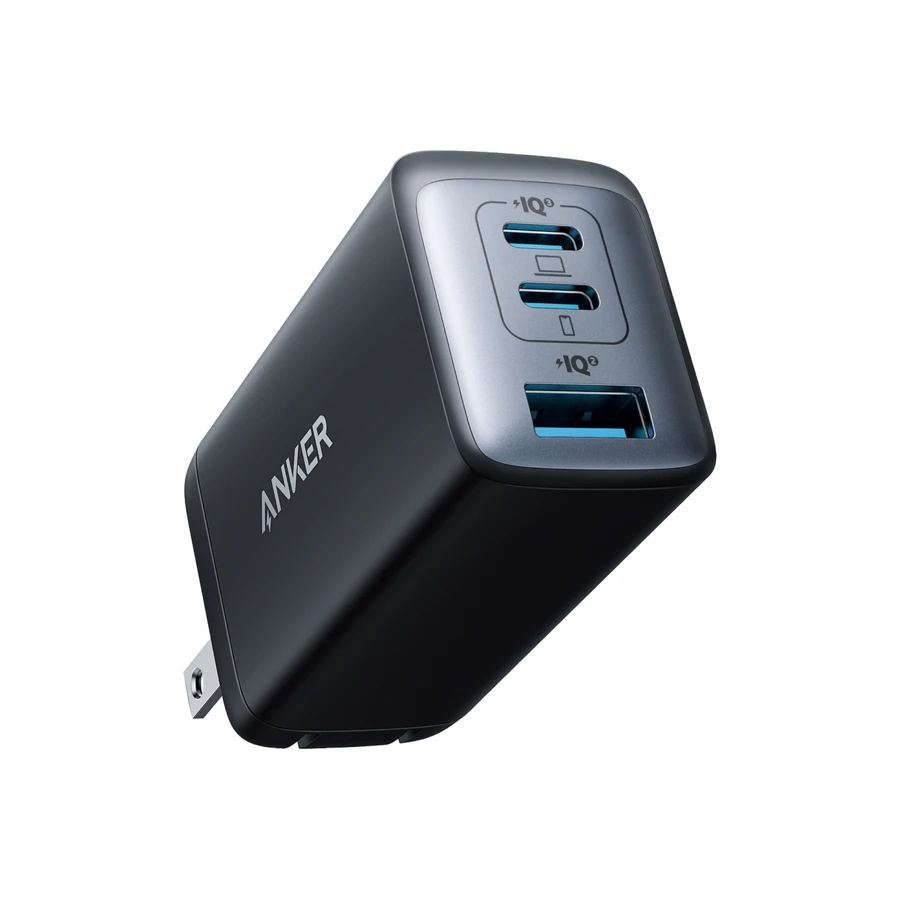
Before buying another charger, look at which socket you are using. On this particular three-port model, changing the pair of occupied ports can matter more than replacing the USB-C cable with a higher-wattage one.
Read the tiny labels first
Identify C1, C2 and USB-A on the Anker 735, model A2667. When a USB-A device is connected, the published C1 pairing retains 40W, while the C2 pairing lists only 12W on that port. That is a 28W difference in the documented maximum. It is not a claim that moving the cable will make every laptop draw 28W more. The actual power still depends on device negotiation and battery state. But if you have been plugging the laptop into C2 while a USB-A peripheral is attached, the charger's budget for that port is simply much lower from the start.
If your current computer needs more than either arrangement offers, changing ports will not finish the job. But if the wrong pairing created the shortfall, knowing the table may avoid an unnecessary purchase.
Photograph your intended configuration
Make a note of the devices that will stay connected together. Match that combination to one row in the manual. Do not add individual single-port ratings together: they describe separate operating cases.
The C1 plus C2 combination is listed at 45W + 20W, suitable for two USB-C devices. C1 plus USB-A is 40W + 22.5W, keeping more capacity on the laptop side. C2 plus USB-A is 12W + 12W, a very different budget.
Keep the table and exact model number with your buying notes. Accessories with almost identical names can have different allocation rules. A seller's answer that only repeats "65W charger" leaves the important question unanswered.
Next time you suspect the charger is failing, ask a specific question: with C1 and USB-A occupied, what power profiles can C1 provide on this model? If the seller cannot produce the relevant manual, choose a product whose documentation makes the arrangement clear. A higher-rated charger becomes worth comparing when your preferred device combination exceeds the useful row, not simply because one charging session seemed slow. Battery state, workload and negotiated profiles can also change what you observe.