In this story
After looking at Apple's official "What Holds Us" sample images, if your first reaction is that you need a new phone, hold on. Those photographs are indeed beautiful, but they are first of all commissioned work within a brand promotional project, not an independent review, and not a guarantee that an ordinary person with the same phone can reproduce them. Reading them as a photography lesson is more useful than reading them as a buying guide. Three photographers received the same iPhone 18 Pro imaging system, yet what they delivered barely overlaps. That fact itself is more worth pondering than "how much better the image quality has become again."
The same phone, three ways of seeing the world
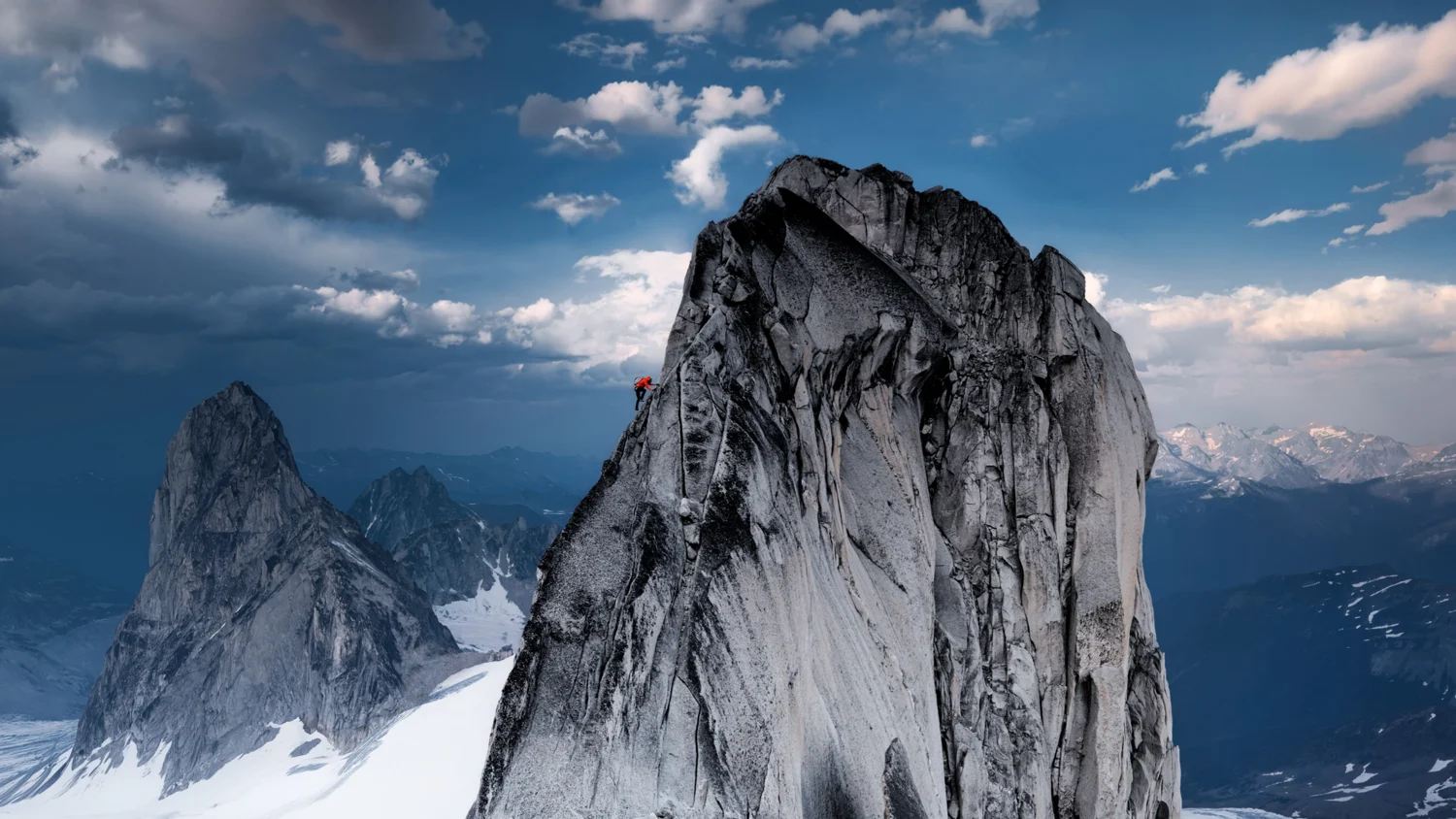
Jimmy Chin photographed the snow mountains of the Bugaboos in southeastern British Columbia, Canada. In the official materials, he used the variable aperture of the 48MP Fusion Main camera to hold the scale of the mountain, and also used the telephoto to extract patterns formed by snow, ice, and glaciers. He mentioned that what he cared about was not the equipment but what was in front of him—a few inches of rock and ice, or an entire panorama, both of which he hoped would still hold up when enlarged. In the images, climber Conrad Anker is sometimes in close-up, and sometimes only a tiny figure at the center of an immense panorama. This treatment makes the relationship between "person" and "mountain" very clear: in such a composition, the tiny figure can be read as a reference for sensing the scale of the mountain. [1]
Jack Davison took another path. In a photography studio converted from an old sugar warehouse in London, he had his subjects interact with clay and chalk. Some smeared clay on their bodies and became a kind of human sculpture; others left fingerprints and traces. In the official report, what he repeatedly talked about was "intimacy"—the phone is not held in front of the face, it can be lowered, and eye contact can be maintained. His black-and-white contrast is strong, and Ryan said that the quality of highlights and shadows was achieved without a darkroom. What is truly interesting here is not "the phone can shoot black and white," but how the photographer places the phone and whether eye contact is maintained can also become choices worth noticing outside the frame; this is not a guarantee of how the subject will react. [1]
Alex Prager, by contrast, aimed her lens at crowds. At one moment she used a bird's-eye view to create the illusion of a seemingly continuous crowd, and at another she zoomed in to observe the inner state of one person within the crowd. In the official description, her images resemble film stills: confetti on the ground, a retro bus, neon signs, a "Star Maps Here" sign; the party seems to have just ended, yet also seems still to be going on. Ryan said her work makes people feel "not that they are looking at captured moments one by one, but that they are watching the scene unfold," with the seconds before and after still present. This narrative feeling is not completed by any single lens; it can be understood as staging, color, viewpoint, and timing working together, and one cannot infer the effect of a particular parameter from the photographs alone. [1]
Three people, three scales: Chin is person and nature, Davison is person and person, Prager is person and crowd. The equipment is the same, but the choices are completely different. This precisely shows that what the phone provides is a set of capabilities, not a ready-made work. [1]
Exercise one: first decide whether the person or the scene is larger
If after seeing Chin's mountain images you feel an itch, do not rush to place an order. With your current phone, find a place you can safely reach that also has some layering—a city footbridge, a riverside walkway, or a park with a distant view will all do. In the same scene, shoot three images: one where the person occupies a very small part of the frame, one where the person occupies a medium part, and one where the person is close enough that you can clearly see their expression or action. When reviewing, ask yourself: in which image is the relationship between the person and the environment clearest? Is the person within the scene, or has the scene swallowed the person? In Chin's panorama, Anker is only a small dot, but it is precisely this small dot that makes the scale of the mountain perceptible. What you need to practice is not "shooting a big mountain," but deciding how much of the frame the person should occupy.
This exercise does not require mountain climbing, nor an extreme environment. What it trains is judgment: what exactly do you want the viewer to see first. After shooting, place the three images side by side, and you will find that "scale" is not a lens parameter but a choice of position and proportion.
Exercise two: lower the phone and see whether the gaze is still there
In Davison's clay portraits, what is most worth learning is not the black and white, but what he said about "not putting something in front of your face." You can find someone willing to be photographed—a family member, friend, or colleague—and first get their consent. With your current phone, shoot two sets: one following your usual habit, raised to eye level; the other with the phone lowered to around chest height, trying to maintain eye contact with the other person, and then pressing the shutter. After shooting both sets, compare them: in which set is the other person's gaze more natural? Which set feels more like "being photographed," and which more like "being seen"?
Here you should note that you should not treat "lowering the phone" as a universal formula. Some people become more nervous after it is lowered, while others relax more when it is raised. The purpose of the exercise is to make you aware that the act of photographing itself changes the person being photographed. What Davison described in the official materials is his own feeling, not a law for everyone. What you need to find is the distance and height that suit you and the person being photographed. Before photographing people, ask first, and after photographing, show them the result. These basic courtesies matter more than any technique.
Exercise three: find a "few seconds before and after" within a crowd
Prager's crowd staging is the hardest for ordinary people to reproduce, because it involves a great deal of organization and set design. But there is one thing you can practice: in a real crowd scene, find those few seconds between "what is happening" and "what has just happened." A weekend market, a subway station exit, or a school gate are all safe and accessible places. With your current phone, first shoot a wide-angle image to take in the overall relationship between the crowd and the environment; then shoot a medium-to-long-focal-length image, choosing one person or one group of people, and look at their actions and expressions. When reviewing, ask yourself: in the wide-angle image, does the crowd form some kind of rhythm? In the telephoto image, is there a moment that makes you feel "what will happen next second"?
In Prager's official work there are confetti, a retro bus, and neon lights; that is a constructed world. You do not need to replicate that world. What you need to practice is recognizing, in ordinary scenes, the moment when "narrative is unfolding." This exercise does not guarantee a good shot, but it can make you more sensitive to timing.
So should you actually change phones
The opposing view must be stated clearly: if your current phone is clearly insufficient at a focal length you truly need—for example, if you often photograph distant people or objects, and the telephoto crop of your current model is already unusable; or if you need a RAW workflow and your current model does not support it—then the 48MP Fusion system, variable aperture, and ProRAW of the iPhone 18 Pro are indeed supplements in terms of capabilities. The specifications page confirms variable aperture, the 48MP camera system, and Apple ProRAW support, but these capabilities cannot be directly converted into a certainty that your final images will be better. [2]
But if you merely feel after seeing the sample images that "it seems better looking," first use your current phone to do the three exercises above. After finishing, you may find that what is missing is not that lens, but the position you stand in when shooting, the timing of pressing the shutter, and the distance between you and the person being photographed. The official sample images are an Apple promotional project; the report presents works that three photographers each designed and selected, and one cannot infer unwritten equipment or team configurations from them. The exhibition itself is also not a guarantee that ordinary people can directly reproduce it. Treating equipment as capabilities and exercises as a means of verification is more reliable than treating sample images as a reason to upgrade. [1][2]
There is one more thread in this exhibition worth keeping. It was curated by Kathy Ryan and revolves around connection between people and between people and their environment; the New York exhibition opens on September 18. [1] The three groups of photographs are not random sample shots taken by wandering around with a new phone. They serve the same proposition, yet they were not made into the same answer. What ordinary readers can borrow, first of all, is also setting a question for a group of photographs. For example, record a piece of work completed together, or the changes in the same place over the course of a day; this is an exercise direction you can try on your own, not the original exhibition's shooting assignment.
After shooting, do not rush to use filters to pull the whole set of photographs into the same tone. You can select three of them and write down what each one adds. If the second is merely a repetition of the first, and the third also brings no change in relationship or action, try deleting one. This choice trains the structure of a photo series. The same device and the same subject do not require the same composition; only when there are differences between photographs do they have a chance to tell one thing together.
You can also keep a record of evidence for an upgrade need. Which photograph could not be taken because of distance limits, which one had a problem in operation or focus, and which one was simply not thought through in composition—write these down separately. The first kind of problem may require studying different focal lengths or device capabilities; composition problems can first be addressed through practice. As for whether new hardware can solve a specific limitation, that still depends on reliable tests under the corresponding conditions; selected exhibition works from the manufacturer cannot replace comparison.
If you ultimately decide to change phones, you can take the same exercises to test the new device. Is it easier to organize the frame? Is the shooting method you need supported? Is the post-processing workflow smoother? Judgment should revolve around the needs you wrote down in advance. Such a reason to buy does not require belittling the good-looking official works, nor does it require making your old phone sound worthless. Appreciating works and buying equipment can happen at different times; first take away the parts worth learning.
Mentioned in this story
These links lead to official or retailer pages. We currently earn no affiliate commission from them. Check the destination for regional availability, configuration and pricing.
iPhone 18 Pro View official specifications ↗